 Australian Made Mats


You open the back door.
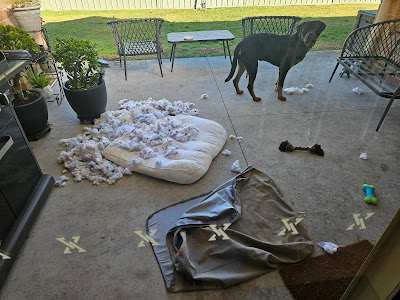
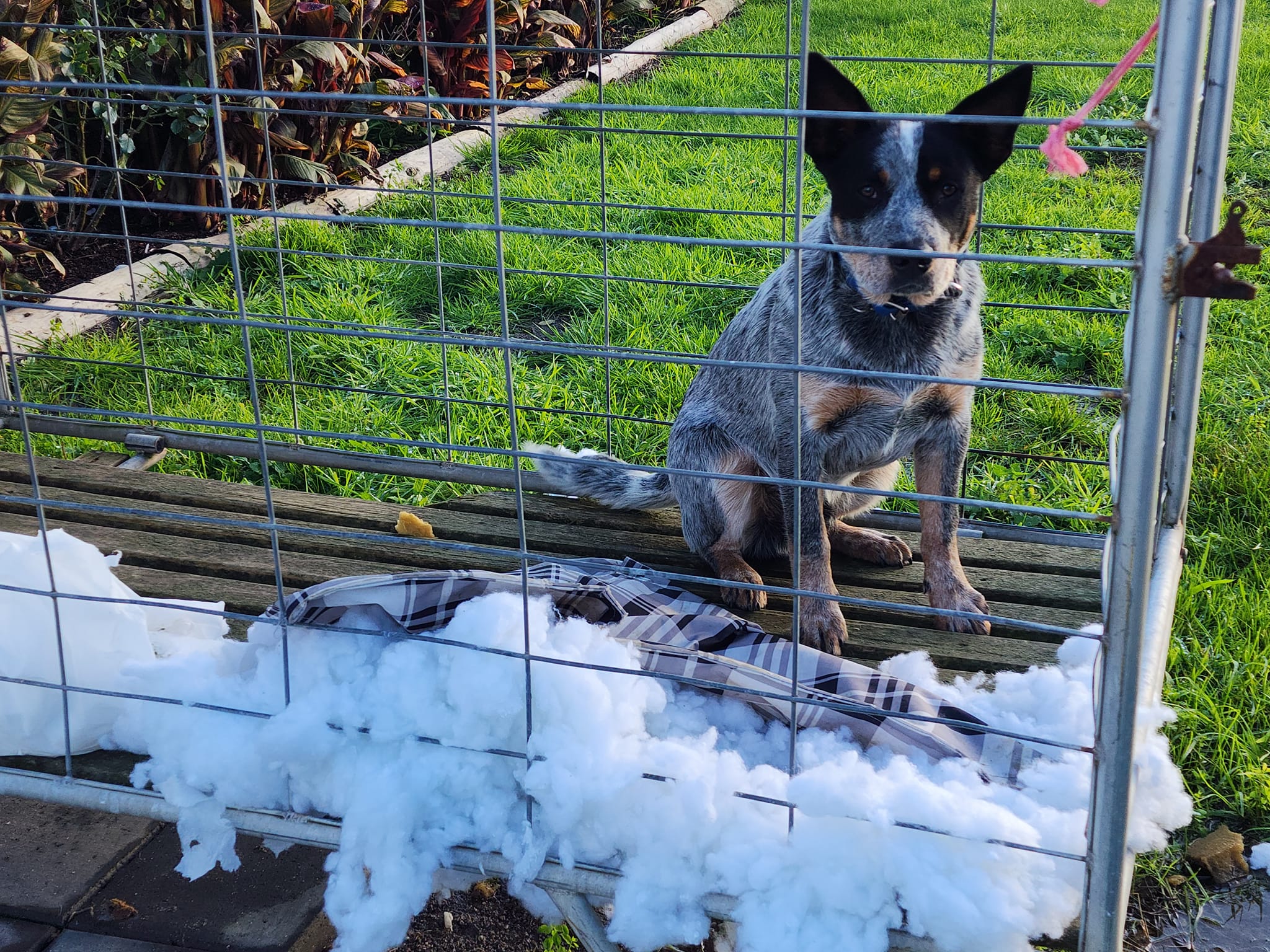
There is foam across the deck. Fabric scattered, some even caught in the railing. Something that used to resemble a dog bed is now resembling roadkill from the Warrego highway.
And sitting in the middle of it all is your dog, looking pleased with themself, not guilty at all, but maybe a little anxious.
At the least completely unaware that the scene behind them has just cost you another $200 plus.
Your first question is usually: Why do they keep doing this?
Then the harder questions arrive.
- Are they bored?
- Are they distressed when I leave?
- Have I done something wrong?
- Is my dog normal?
Let us clear up one thing first: your dog is not bad, and a destroyed bed does not mean you have failed them.
Chewing is normal canine behaviour, especially in puppies and adolescent dogs.
It can help dogs explore, relieve teething discomfort and occupy themselves.
But boredom, stress, frustration, pain and separation-related distress can all make it more intense.
A shredded bed is evidence.
Not a diagnosis.
First: This is not your fault
Owners of destructive dogs often carry far more guilt than they admit.
You walk them, feed them, buy toys, pay vet bills and rearrange your day around them.
Then another bed explodes and you wonder whether the damage is proof that your dog is unhappy.
Public owner discussions (on Socials and Reddit etc.) circle the same worries again and again:
- Am I leaving them too long?
- Is the crate making it worse?
- Do they need more exercise?
- Should I remove the bed?
- What if they swallow the stuffing?
Those are sensible questions, not evidence of bad ownership.
Understanding the behaviour is about replacing guesswork with a better plan.
What bed destruction can mean
The most useful question is not “Why is my dog so destructive?”
It is “When does the destruction happen, and what does that pattern tell me?”
1. Normal chewing, teething and exploration
Like sharks, puppies investigate the world with their mouths.
Unfortunately, the world includes shoes, chair legs and the new bed you bought yesterday.
This type of chewing is usually relaxed and opportunistic.
It may happen while you are home, during energetic periods or whenever an appealing seam or corner becomes available.
- Your dog is a puppy or adolescent.
- They chew toys and household items as well as bedding.
- They can be redirected to an appropriate chew.
- The damage is gradual rather than frantic.
What helps: safe chew toys, supervision, rotating enrichment, removing tempting items and choosing bedding without exposed edges, seams and loose components.
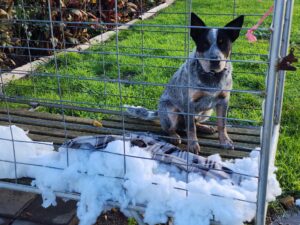
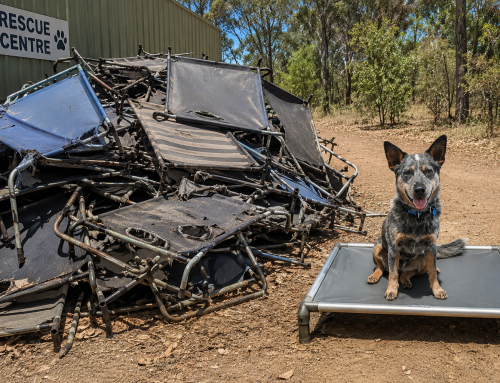
Benni Rosman – Doing what Cattledogs do
2. Boredom or unmet physical and mental needs
A dog can be physically tired and still mentally unemployed.
A walk may exercise the legs without giving the brain much to do.
Working breeds, retrievers, terriers and energetic crossbreeds often need opportunities to sniff, search, learn and solve problems.
Without those outlets, they may create a project.
Your bed has corners. Corners become openings. Openings become a mission.
- Destruction occurs during long, quiet periods.
- Your dog targets several objects, not only their bed.
- They settle better after sniffing, training or food enrichment.
- The chewing looks deliberate rather than panicked.
What helps: vary the dog’s day. Sniffing walks, short training sessions, scatter feeding, food-dispensing toys and safe chews can be more useful than simply adding another lap around the block.
3. Separation-related distress
This is the possibility owners worry about most, but one shredded bed is not enough to diagnose it.
Separation-related distress usually involves a cluster of behaviours linked to your departure or absence. The pattern matters more than the damage itself.
- The behaviour begins soon after you leave.
- Damage is concentrated around doors, windows, gates or exits.
- Your dog pants, drools, paces, howls or barks persistently.
- They refuse food or a favourite enrichment toy after you leave.
- They attempt to escape or injure themselves.
- The behaviour appeared after a move, schedule change or household change.
A bored dog may dismantle a bed because it is entertaining.
A distressed dog may destroy it because their nervous system is in overdrive.
Those are not the same problem and should not receive the same treatment.
Do not punish the aftermath. Your dog cannot reliably connect your anger when you return with something they did hours earlier. Punishment may only teach them that your return can be frightening.
4. Frustration, confinement or the wrong setup
Some dogs cope well alone in an open room but panic in a crate. Others feel secure in a crate but become unsettled with access to the entire house. Some are comfortable indoors but frustrated in an exposed outdoor run.
Look at where the behaviour happens.
Is the dog trying to escape, or simply working on an easy corner?
Is the area hot, noisy or uncomfortable?
Does the bed slide, bunch or expose a tempting edge?
Has the dog been gradually introduced to the space?
Containment and calm can look identical from outside the room. A camera usually tells you which one you are seeing.
5. Pain, discomfort or a health issue
Behaviour can change when a dog is uncomfortable.
A dog who suddenly begins destroying bedding, pacing at night or struggling to settle should not automatically be labelled bored or difficult.
Arrange a veterinary check when the behaviour starts suddenly, your dog is older, sleeping or eating patterns change, they seem restless or painful, or the destruction appears alongside other symptoms.
If you think your dog has swallowed fabric,
foam, stuffing or pieces of bedding,
Contact Your Veterinarian.
Vomiting, lethargy, reduced appetite, abdominal discomfort or difficulty passing stool can signal a serious blockage.

Benni Rosnan – Relaxing on their Indestructible ChewProof Bed
A quick way to read the pattern
| What you observe | What it may suggest |
| Puppy chewing many different objects | Teething, exploration or limited impulse control |
| Calm, methodical dismantling during quiet periods | Boredom or a rewarding chewing habit |
| Destruction soon after departure with pacing, drooling or vocalising | Possible separation-related distress |
| Damage focused around doors, gates or windows | Escape behaviour or confinement distress |
| Sudden behaviour change in an adult or older dog | Pain, discomfort or another health issue |
| Digging and scratching before lying down | Normal nesting behaviour that the bed cannot withstand |
| Dog settles better after enrichment or training | Under-stimulation may be contributing |
| Dog ignores favourite food once left alone | Distress may be more likely than boredom |
This is not a diagnostic test.
It is a starting point for deciding what information to collect and who may need to help.
What can you do now?
1. Make the area safe
Remove damaged bedding and check for loose fabric, foam, thread or plastic that could be swallowed.
Do not keep putting an actively shredding dog back with the same unsafe material and hope they have undergone a spiritual transformation overnight.
2. Record what happens after you leave
A basic indoor camera can answer questions that guesswork cannot.
Record at least the first 30 to 60 minutes after departure.
- How quickly does the behaviour begin?
- Does your dog pace, pant, bark, howl or drool?
- Will they eat?
- Do they settle?
- Does the destruction look frantic or recreational?
“Started chewing after four quiet hours” tells a very different story from “panicked two minutes after the door closed”.
3. Keep a short behaviour log
For seven days, note exercise, training, meals, enrichment, time left alone, sleeping location and any destruction. Patterns often appear quickly once they are written down.
You may find that damage is worse after missed walks, during storms, after visitors, in one room or whenever a soft bed presents an exposed seam.
4. Meet the need before asking for calm
Before leaving your dog, provide a sensible mix of toileting, movement, sniffing, short training and food enrichment.
The goal is not to exhaust the dog into unconsciousness. It is to meet their needs well enough that rest becomes possible.
5. Build independence gradually
For mild concern about being alone, practise short, manageable separations and return before distress escalates.
For moderate or severe separation distress, get individual professional guidance.
Repeating longer absences while the dog panics is not gradual training. It is repeated panic with a stopwatch attached.
6. Match the bed to how your dog destroys things
The best bed is one that safely suits the dog’s real behaviour.
- Diggers and scratchers need a taut surface that resists repetitive pawing.
- Dogs that hunt seams and corners need exposed grab points eliminated.
- Wet or outdoor dogs may need airflow, drainage and fast cleaning.
- Persistent chewers may need a stronger setup with protected or inaccessible edges.
- Dogs wanting softness may suit a protected-edge pillow top rather than a loose cushion.
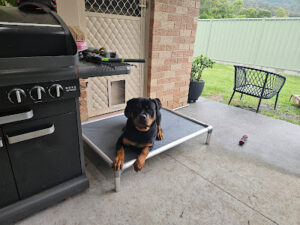
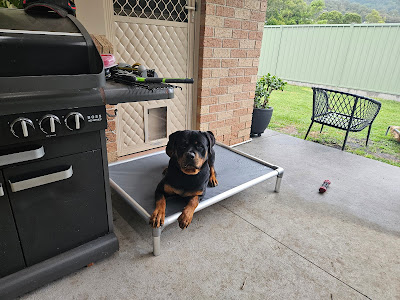
A Rotti enjooying their indestructible ChewProof bed
Where a tougher bed fits
A more durable bed can remove part of the problem. It can reduce exposed seams, loose corners, access to stuffing, repeated replacement and the opportunity to rehearse the same successful destruction.
ChewProof beds use an elevated aluminium frame with replaceable mat options for different behaviours and environments.
Riplock is suited to dogs that dig, paw and scratch.
ToughMesh prioritises airflow and drainage.
Protected-edge pillow-top options add softness without presenting the same loose edge as a conventional cushion.
A heavier Industrial Strength option exists for the small group of dogs requiring something more extreme.
But a bed is not a treatment for panic.
Aluminium cannot cure separation anxiety, and a durable sleep setup should never be used to ignore a dog that is distressed, escaping or injuring themselves.
Think of the bed as an environmental tool: something that can make the space safer, calmer and less rewarding to destroy while you work on the underlying cause.
When should you get professional help?
Speak with your veterinarian when the behaviour begins suddenly, your dog may have swallowed part of a bed or cushion, there are changes in appetite, toileting, sleep or mobility, or you suspect pain or illness.
Seek help from a qualified reward-based trainer or veterinary behaviour professional when your dog panics when left, injures themselves trying to escape, cannot settle even for short absences, vocalises for long periods or the behaviour is getting worse.
Getting help is not admitting failure. It is what responsible owners do when the problem has moved beyond internet guesses and another chew toy.
So… is your dog normal?
Probably more normal than the wreckage makes them look.
Dogs chew.
Puppies explore.
Energetic dogs become bored.
Some dogs discover that pulling stuffing from a cushion is the greatest recreational breakthrough of their generation.
But persistent destruction can also signal stress, frustration, discomfort or difficulty coping alone.
The answer is not to label your dog or blame yourself.
It is to study the pattern, remove immediate risks, meet the dog’s needs, choose an environment suited to their behaviour and get professional support when the signs point beyond ordinary chewing.
Your dog does not need to be shamed.
You do not need to be blamed.
You both need a clearer plan.
Need help choosing the right sleeping setup?
Tell us what your dog destroys, how they destroy it, where the bed is used and whether they dig, chew, scratch or target exposed edges. We will help you choose the least extreme ChewProof option suited to the problem.
Because the goal is not to turn your dog into someone else’s dog. It is fewer bed battles and more room for the good parts.
Sources and further reading
- RSPCA Knowledgebase: Puppy chewing and destructive behaviour
- RSPCA Queensland: Separation distress in pets
- Animal Welfare League Queensland: Destructive dog behaviour
- Australian Veterinary Association: Reward-based dog training
- Greencross Vets: Vomiting and possible foreign-body concerns
- ChewProof: Dog beds for aggressive chewers
General information only: This article does not replace advice from your veterinarian or a qualified canine behaviour professional.